Objective 1
Develop airspace concepts and technologies to support low volume UAM operations within the current regulatory structure
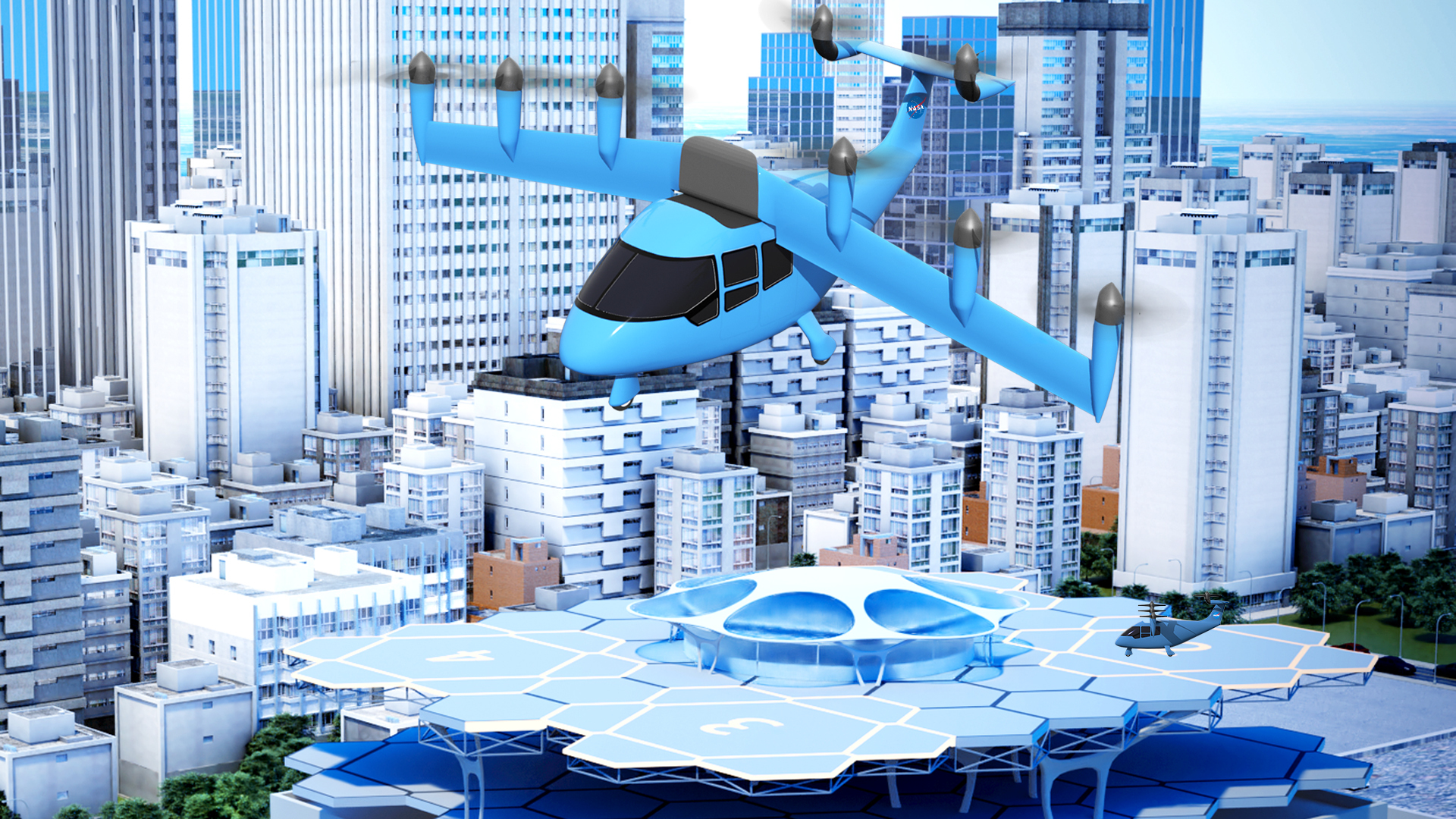
From emergency relief to autonomous air taxis, Urban Air Mobility (UAM) aims to reshape the future through bold innovations. As electrically powered aircraft are expected to fly above urban areas, that airspace will grow increasingly dense and complex.
To safely achieve the high level of operational density and complexity in the schedule desired by the UAM community, new airspace technologies and procedures that enable UAM operators to readily access and operate safely and efficiently in the National Airspace System (NAS) are needed.
Working with industry and the Federal Aviation Industry, the UAM Airspace Management subproject is researching and developing new airspace technologies and constructs. Several airspace technologies are expected to be developed and implemented by industry as third-party services are approved by the FAA. These efforts will enable a high level of operational density and complexity to ensure safe, secure, reliable, and predictable UAM operations.
Develop airspace concepts and technologies to support low volume UAM operations within the current regulatory structure
Develop, evaluate, and deliver recommendations to the FAA on conflict management concepts to enable increasing levels of UAM operations
Design, develop, verify, and transfer to the FAA a robust set of airspace design criteria for medium volume UAM operations
Develop preliminary UAM communications architecture and requirements across the UMLs
Collaborate with industry and the FAA to evolve the notional UAM architecture towards a secure prototype airspace UML-4 architecture to identify and verify airspace UML-4 architecture and requirements
Airspace technologies and constructs that enable initial UAM operations to safely scale as demand increases
Recommendations for integrating with air traffic control for early UAM operations
Vehicle-based performance separation criteria recommendations